Introduction
The integration of advanced technology with the human body has the potential to revolutionize healthcare in ways we are only beginning to understand. While pharmaceutical treatments have significantly advanced over the past century, they still fall short when it comes to addressing complex disorders like Parkinson's disease or epilepsy. For these conditions, existing medications often come with a host of undesirable side effects, leaving many patients without effective treatments. However, recent advances in organic electronics and neural interfacing are going to change this, offering more personalized, time-resolved therapies.
In this exciting and challenging field, the concept of neuroprosthetics – devices that can both listen to and communicate with the nervous system – is at the forefront. These devices, which include technologies such as pacemakers and hearing implants, are already being used to treat a range of medical conditions. However, the next generation of neuroprosthetics aims to push the boundaries further, creating devices that are smaller, faster, less invasive, and capable of adaptive functionality.
How do we build such devices?
This is where you come in.
Project description
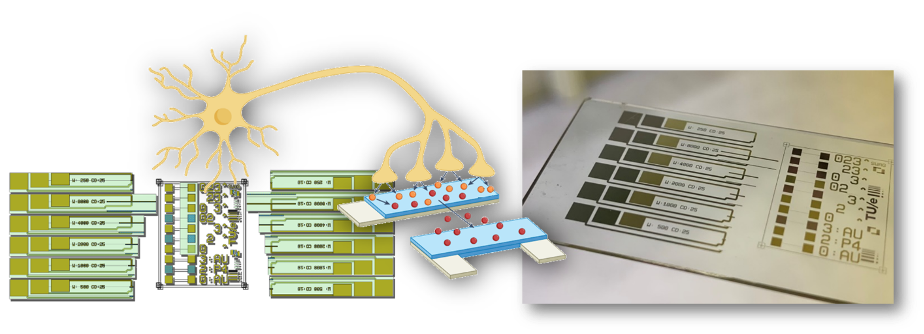
This project will focus on one of the most promising developments in the field of neuroprosthetics: organic electronic devices. By leveraging the unique properties of organic materials, we aim to make fast buy tunable interfaces for biopotential-interfacing, and this all on a single chip.
This interdisciplinary project combines cutting-edge research in organic electronics, material science, and device fabrication, offering students the opportunity to work on technology that contributes to the field of electroceuticals. The ultimate aim is to create chips that are not only functional but also adaptive, allowing them to provide therapy and tune their functioning, thereby minimizing side effects and improving the quality of life for patients.
As a key part of the project, you will engage in the fabrication, testing, and optimization of organic electronic devices that can be used to facilitate the sensing required for a neural-interface. You will be challenged to think creatively and technically to overcome the limitations of current technology, with the goal of contributing to the development of future adaptive neuroprosthetics.
Required skills
· Knowledge of sensors and transistors
· Programming basics (python is preferred)
· Creativity, ambition and enthusiasm are most important of course
We do not expect MSc students to be experienced in microfabrication, but basic theoretical knowledge of photolithography and other microfabrication techniques is preferred, since this will be a major part of the project.
Where will you be working
You will be in Microsystems group with the Neuromorphic engineering team. You will be one of the users of the new lab facilities that just been set up. Also, you will collaborate with a PhD supervisor, working together with lab users of the MicrofabLab here at Eindhoven University.
You want to be an engineer at the interface of neuroscience and electronics?
Email background and motivation to N.J.Burghoorn@tue.nl
References
Zhang, Yanxi, Eveline R.W. van Doremaele, Gang Ye, et al. “Adaptive Biosensing and Neuromorphic Classification Based on an Ambipolar Organic Mixed Ionic–Electronic Conductor.” Advanced Materials 34, no. 20 (2022). https://doi.org/10.1002/adma.202200393.
Roh, Heejung, Camille Cunin, Sanket Samal, and Aristide Gumyusenge. “Towards Organic Electronics That Learn at the Body-Machine Interface: A Materials Journey.” MRS Communications 12, no. 5 (2022): 565–77. https://doi.org/10.1557/s43579-022-00269-3.
Van De Burgt, Yoeri, Armantas Melianas, Scott Tom Keene, George Malliaras, and Alberto Salleo. “Organic Electronics for Neuromorphic Computing.” Nature Electronics 1, no. 7 (2018): 386–97. https://doi.org/10.1038/s41928-018-0103-3.