Would you like to have a meaningful contribution to analysis of experiments? Do you like coding and don’t mind a little freedom? Continue!
Our society is built on metals such as steels and various alloys. Understanding how they behave on a microscopic level allows us to design more advanced materials with highly improved properties. It is critical to understand how materials behave when deformed, for example when being formed into their desired shape to make a component. In the Multiscale Lab, we experimentally examine the microstructure of metals like steel and zinc, and systematically study the relation between plastic deformation and damage, to make metals more formable, durable, and sustainable.
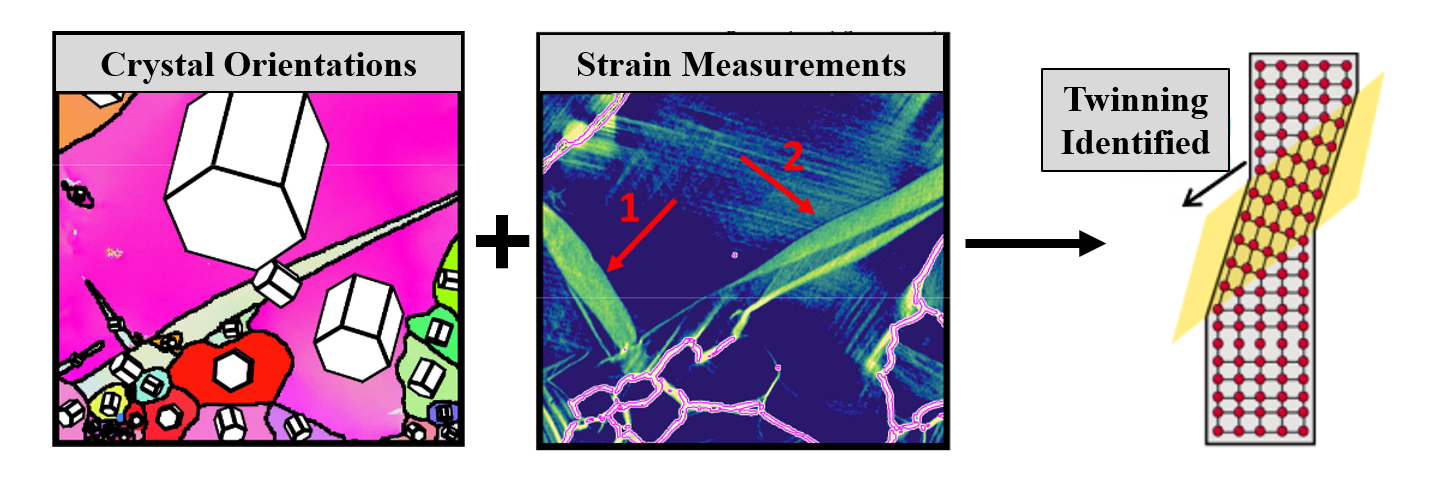
These experiments are performed using Scanning Electron Microscopy (SEM), giving access to high-resolution deformation (strain) fields at the microscale. Together with Electron Backscatter Diffraction (EBSD) measurements of the local crystallographic orientations, this gives us a wealth of data. Using the strain measurements, we can separate the different sources of plasticity active in a microstructure, the most common of which is crystal slip. Another particularly relevant mechanism is twinning: a collective shuffling of atoms which does not only deform the metal, but also changes its local crystal structure. Twinning was observed in Zinc-coated steels, as shown in the cover image. For robust and statistical analysis, there is great need for an automated, robust tool that identifies twinning.
You will be tasked with developing and implementing this twinning identification method, making use of data gathered by previous projects in the Multiscale Lab.
The objective is to develop a method to automatically identify twinning deformation from experimental and synthetically generated data.
This project is structured as follows:
(i) Familiarizing with the experimental data and a pre-existing slip identification method in Matlab (which can only detect crystal slip, and not twinnning)
(ii) Exploring different approaches for identifying twinning
(iii) Testing and calibrating your model on synthetic data
(iv) Validating your method on real, experimental data.
You will contribute to a more robust and complete understanding of plasticity in crystalline materials, which is a very active and meaningful domain in materials science.
Still reading? Want to learn more? Reach out to Casper (c.j.a.mornout@tue.nl) or Bart (b.j.verhaegh@tue.nl) for a coffee!