Background:
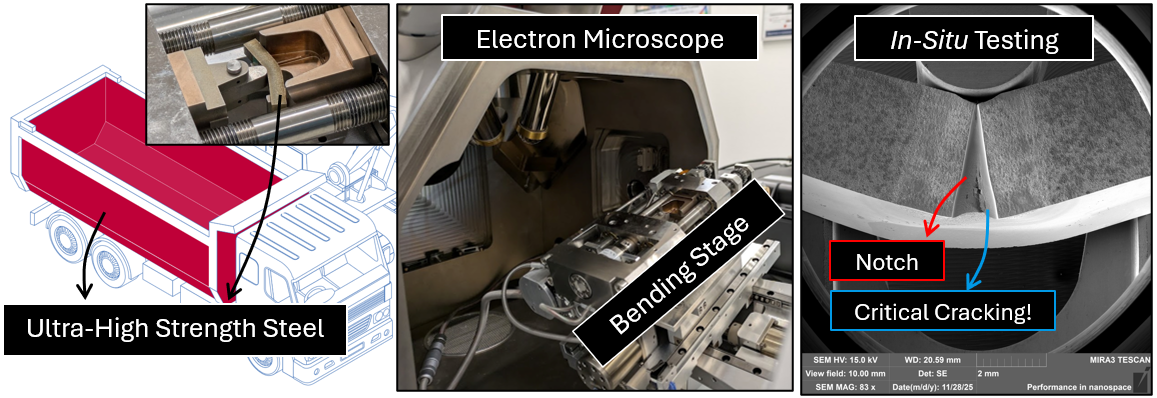
In order to understand and characterize the microstructure of metals, a Scanning Electron Microscope (SEM) is used. Of course, we don’t just want to characterize the materials, we want to deform them as well, to understand their plastic deformation and failure mechanisms. At the Multiscale Lab at TU/e, we can deform our samples live (in-situ) in the SEM by placing a tensile stage inside the vacuum chamber, and imaging the specimen as we deform.
In this particular project, the bending behavior of Ultra-High Strength Steels (UHSS) is of interest. UHSS are very strong and used for applications where strength and wear resistance are critical, like agricultural equipment, truck beds, or mining drills. Because they are so strong, UHSS are known to crack under bending, which needs to be investigated in more detail. Using a specifically designed bending clamp (shown in the cover image), we can bend specimens in-situ at high forces up to 10,000 Newton.
In order to localize the damage in a specific region, we add a small notch in the bending specimen. A typical example of a bending experiment with the notch is seen below:
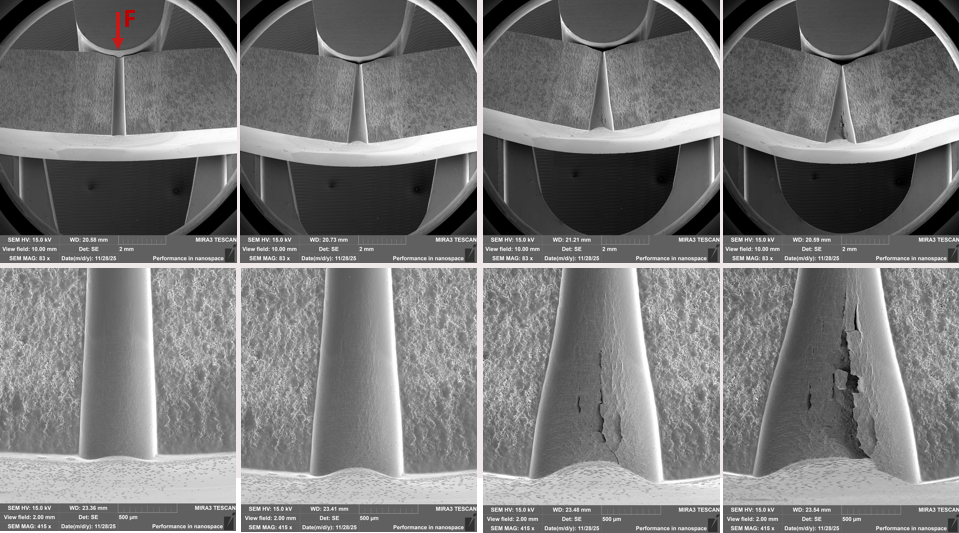
Fig. 1: Top-view of an in-situ bending experiment inside the SEM using a bending specimen with a notch, showing that damage localizes in the notch region
Now, it is time to truly dive deeper into the failure mechanisms of high-strength steels. In this project, you will perform in-situ experiments inside the SEM, using notched high-strength steel beams, to unravel the plastic deformation and damage mechanisms that govern the material. This will enable the steel industry to improve these steels, making them more damage-resistant and sustainable. So, if you are looking for a project that combines experiments at the microscale with creative data analysis, look no further!
What you will do:
Become familiar with a wide range of experimental techniques in the Multiscale Lab:
Specimen preparation
Scanning Electron Microscopy and Electron Backscatter Diffraction
Digital Image Correlation to measure strains at high resolutions
In-situ bending experimentation
Analyze and choose the most suitable sample geometries, and use those to perform in-situ experiments
Analyze the data from your experiments to find out:
What are the most important plasticity and damage mechanisms in high-strength steels?
How can we change the microstructure of these steels to improve their performance?