Description
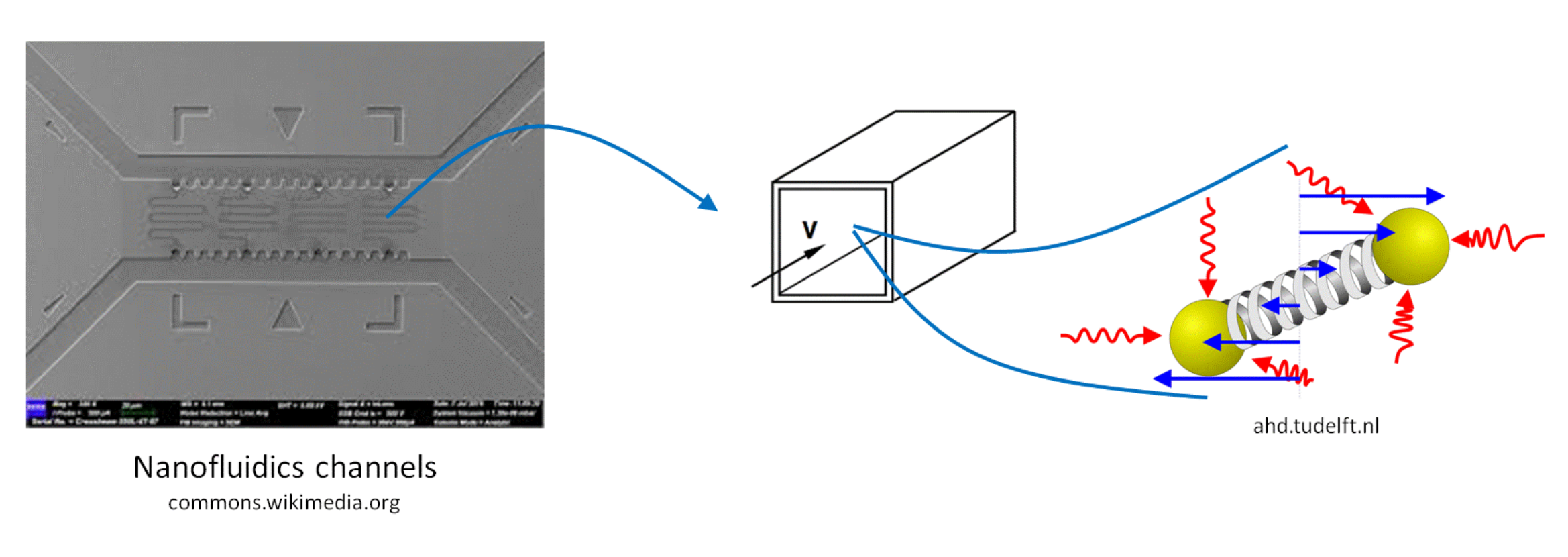
Micro- and nano-fluidic devices are increasingly popular, e.g., for medical applications. The downscaling in these devices is beneficial if only small amounts of fluid are available, or if many experiments are carried out (simultaneously). However, the smaller the device (i.e., thin channels), classical fluid mechanics may no longer apply as fluctuations become relevant. For example, for (bio-)polymer solutions, the finite size of the polymer compared to the channel width cannot be neglected. A few years ago, we have implemented a method for considering such finite-size effects for Newtonian fluids [1]. More recently, we have developed a procedure for considering such finite-size effects for viscoelastic fluids as well [2,3].
Project objective and approach
The goal of this project is to use numerical simulation (FEM) to analyze the flow of a polymer solution in a small-scale contraction flow, and in a small channel with obstacles. For that, we will use an in-house code (TFEM), that currently has the basic ingredients implemented. This includes the so-called b-formulation for viscoelastic fluids [3] and the additional fluctuating terms [2]. However, the latter have only been tested in a single-point simulation. For describing flows, the b-formulation and the additional terms need to be used and evaluated in a flow where spatial gradients become important [4].
Tasks
Redo a few of the one-point simulations in [3] and flow computations in [4] to get familiar with the current code.
Start with a straight channel flow with periodic boundary conditions to combine inhomogeneous flow conditions and fluctuations.
Contraction flow: For different gradual contraction geometries having smooth boundaries, examine the effect of the strength of fluctuations (temperature) on the presence, stability, and size of vortices in the inlet zone.
Small channel with obstacles: Examine how the flow profile and the forces on the obstacle are affected by the fluctuations, for different obstacle sizes and obstacle-wall spacings.
References
[1] De Corato, M., Slot, J.J.M., Hütter, M., D’Avino, G., Maffettone, P.L., Hulsen, M.A. (2016).
Finite element formulation of fluctuating hydrodynamics for fluids filled with rigid particles using boundary fitted meshes.
J. Comput. Phys., 316, 632.
DOI: 10.1016/j.jcp.2016.04.040
[2] Hütter, M., Hulsen, M.A., Anderson, P.D. (2018).
Fluctuating viscoelasticity.
J. Non-Newtonian Fluid Mech., 256, 42.
DOI: 10.1016/j.jnnfm.2018.02.012
[3] Hütter, M., Carrozza, M.A., Hulsen, M.A., Anderson, P.D. (2020).
Behavior of viscoelastic models with thermal fluctuations.
Eur. Phys. J. E, 43, 24.
DOI: 10.1140/epje/i2020-11948-9
[4] Carrozza, M.A., Hulsen, M.A., Hütter, M., Anderson, P.D. (2019).
Viscoelastic fluid flow simulation using the contravariant deformation formulation.
J. Non-Newtonian Fluid Mech., 270, 23.
DOI: 10.1016/j.jnnfm.2019.07.001