Nuclear fusion power plants could provide a green, safe, compact, and continuous source of energy by transforming hydrogen isotopes into helium. However, no solid material can withstand the high temperature and particle flux released on the walls of the reactor. Consequently, the research group is exploring the use of a liquid metal surface supported by a 3D-printed porous tungsten structure that retains the liquid metal through capillary forces.
Additive Manufacturing (AM) is a remarkable technique used to fabricate components with near-net shape. Among the various AM methods, Laser Powder Bed Fusion (LPBF) stands out as a prominent process for fabricating metallic parts. In LPBF, a high-powered laser selectively melts layers of metal powder to build the component layer by layer, achieving complex geometries with high precision and material efficiency. The micrometric melt pool involves high thermal gradients and solidification rates. Tungsten, being a refractory material, has excellent properties for such applications, but its manufacturing using LPBF is very challenging.
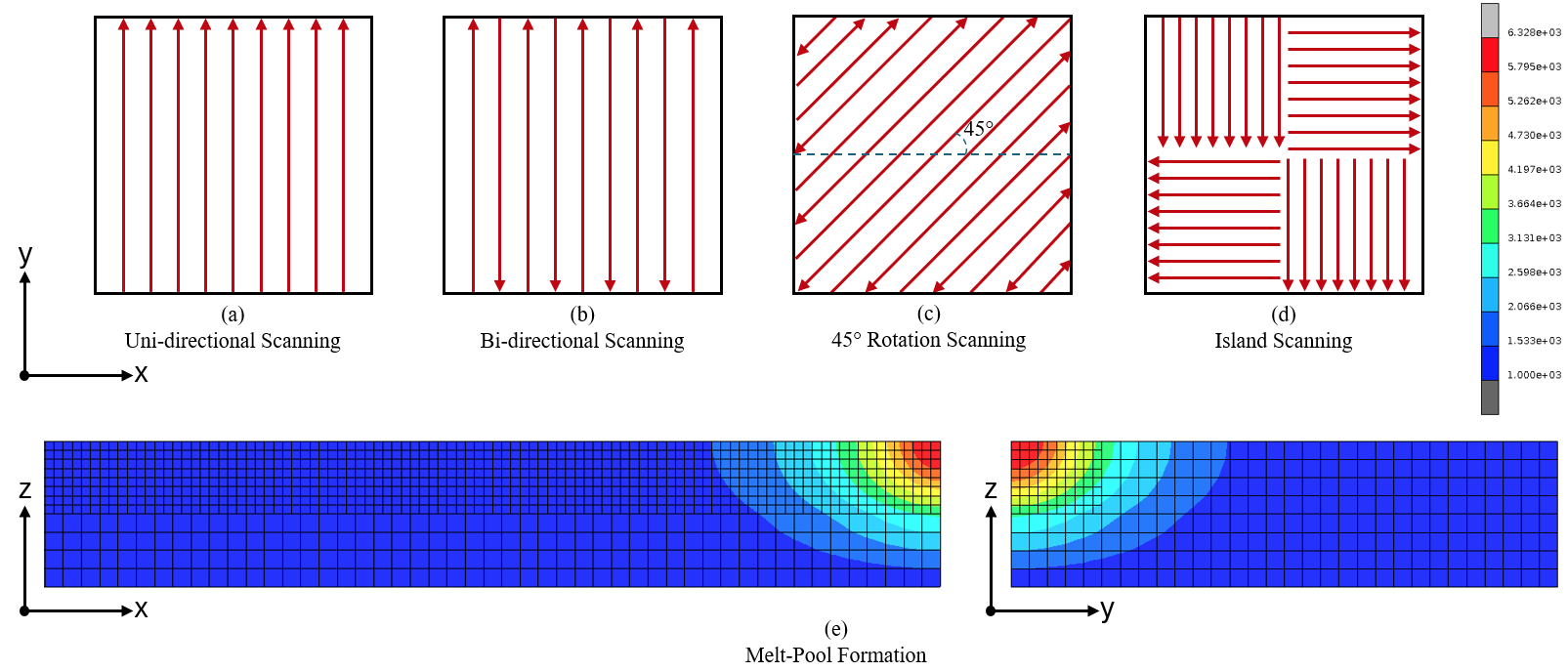
Figure 1: Different Scan Strategies and melt-pool formation in Additive Manufacturing
Different scanning strategies (as shown in Figure 1) can be used during the fabrication of the three dimensional part. The scanning strategy directly influences heat accumulation, melt pool geometry, thermal gradients, and the development of residual stresses. Understanding the influence of scanning strategies on the thermal behavior of the process is therefore essential to optimize part quality and process reliability. Numerical modeling, particularly finite element–based thermal simulations, provides an effective framework to systematically study these effects under controlled conditions.
Your tasks will be:
1. Conduct a literature review on numerical modeling of the Laser Powder Bed Fusion process involving different scanning strategies.
2. Develop a single layer finite element–based thermal model and study the effect of different scanning strategies on the thermal field.
3. Validate the study with the published literature data.