Colourful mechanical research
Oil paintings often exhibit various forms of mechanical deterioration, such as the formation of micro-cracks (known as craquelure) and delamination of paint layers, which can potentially lead to paint flaking.
A crucial factor in the mechanical deterioration of paintings is the mechanical properties of the oil paint itself. These properties are highly sensitive to environmental conditions, such as temperature, relative humidity, age, and mechanical loads. These properties also vary with pigment type, manufacturer, and chemical state. Oil paint can be regarded as a complex polymer system containing rigid pigment particles, which makes predicting its behaviour particularly challenging.
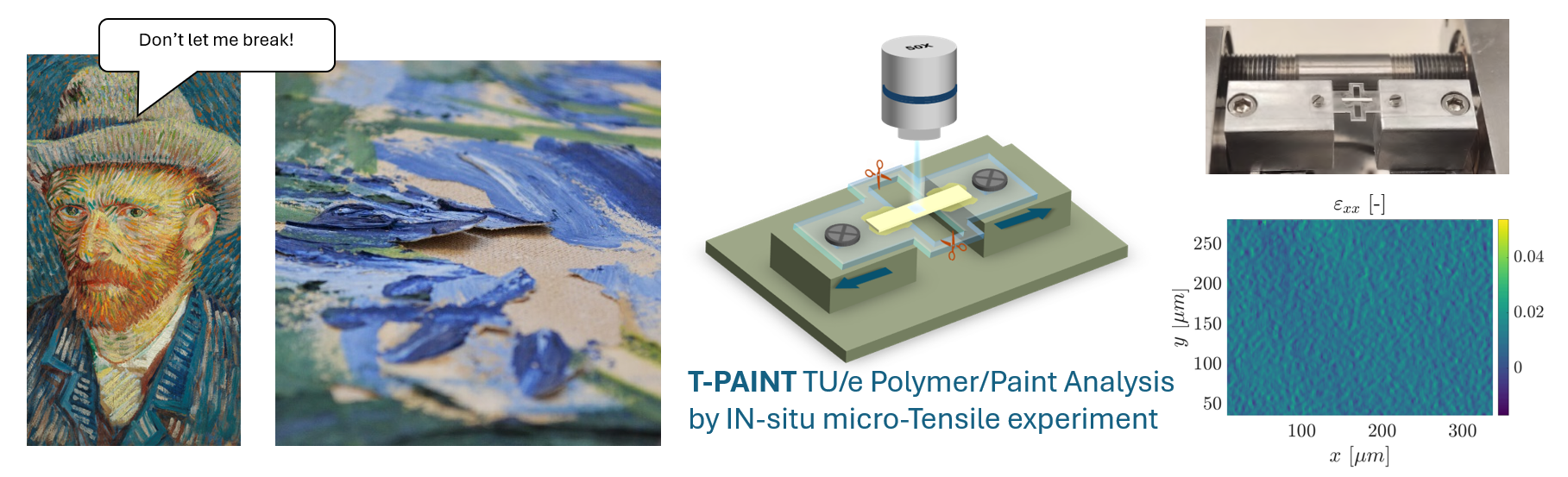
Before we can tackle the full complexity of real artworks—with their many layers and mixed materials—we must first understand the fundamental mechanics of the paint alone. To do this, we have developed T-PAINT (TU/e – Polymer/Paint Analysis by IN-situ micro-Tensile experiment), a new technique to investigate the mechanical behaviour of oil paint samples. In this project, we will apply T-PAINT to delicate paint samples currently used in delamination research, enabling us to support and explain the mechanical failure of the paint layers.
The objective is to characterise the mechanical behaviour of specific oil paints and to familiarise yourself with the T-PAINT method.
The approach will be to test the mechanical properties of commercial artist oil paints with micro tensile tests and digital image correlation (DIC). A particular focus will be placed on refining indium–tin speckle patterning for accurate DIC measurements.
The project offers firsthand experience with delicate experimental testing, optimisation, and data analysis, while contributing valuable knowledge on the mechanical behaviours of complex oil paints.