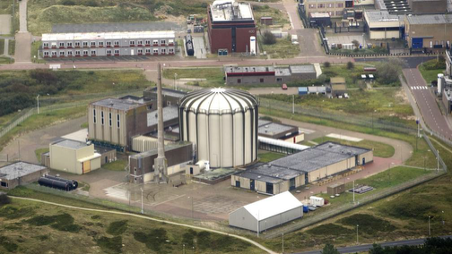
Aluminum alloys containing magnesium and silicon are frequently used as structural materials in nuclear Research Reactors (RR), such as the high-flux reactor in Petten (see Fig. 1a). Over the lifetime of the reactor, these alloys absorb neutrons of various energies. Fast neutrons (high energy neutrons) cause dislocation loops and voids to form whereas thermal neutrons cause the transmutation of aluminum into silicon. The silicon then draws magnesium out of solid solution and forms Mg2Si precipitates as well as Si-rich precipitates, which are generally found on the grain boundaries. Crystallographic slip is then hindered by these inclusions, and the grain boundaries are weakened. This process is believed to change the failure mechanism from ductile to brittle (Fig. 1b).
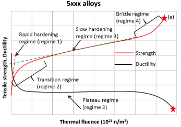
Figure 1: (a) High-flux reactor Petten (source: ANP). (b) Evolution of tensile strength with thermal fluence (source: Kolluri et al., 2017)
A model is currently being developed to simulate the precipitation and defect evolution as the Al-alloy is being irradiated. The aim of this graduation project is to translate these results into local stress-strain data at various points in the matrix and grain boundaries using a crystal plasticity model. As precipitation and defect concentration increases, the material is expected to embrittle as crystallographic slip is hindered. The evolution of the mechanical properties and the associated failure probability can be used to assess the life-time of the structural material.