Introduction
Lately, Artificial Intelligence has seen a significant growth in utility with the ability to solve increasingly complex problems. However, the required energy to operate these systems has also significantly increased [1]. To tackle this future problem, the neuromorphics field has taken inspiration from the brain and designed devices that both function as memory and processor [2], which is different from the conventional software architecture. These devices are constrained by their physical properties, which result in difficulties when implementing conventional learning algorithms. That is why it’s crucial to explore alternative learning strategies that may utilize these physical properties. [3]
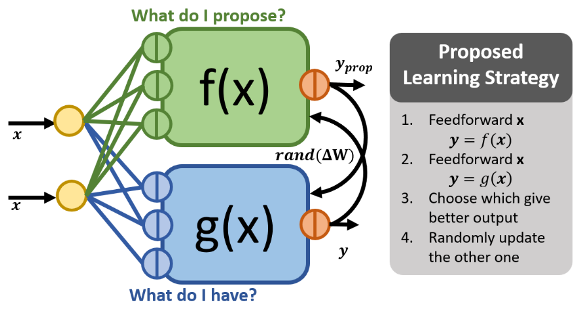
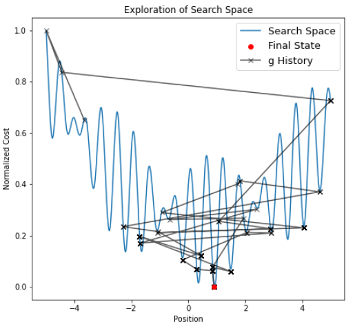
Figure 1. Left: Visualization of the adapted Simulated Annealing learning strategy, where two networks try to present a possible solution and the worst solution is randomly updated to generate another proposed solution in the next round. Right: xploration of Search Space: The plot shows the exploration of the search space by the simulated annealing algorithm. The normalized cost function is plotted against the position, with the final state marked in red and the history of g values marked in black.
Project description
One of the learning algorithms that we want to focus on is Simulated Annealing (SA). Simulated Annealing compares an alternative state to its current state and if the state is better, accept the alternative and its alternative state. The benefit of this algorithm is that it does not require knowledge of the weight values. The network can be observed as a black box. We’ve adapted the classic SA system to consist of two networks that duel to present the best solution, where the losing network is randomly update to improve its suggestion, as shown in Figure 1 left. In a previous BEP project we have shown that our adapted SA algorithm is able to find the global solution, as shown in Figure 1 right. Within this project we want to continue and realize the algorithm in hardware, where the system can autonomously adapt its behavior to achieve its goal.
The proposed design of the project has the following goals:
· End goal – Realize a physical network that can learn to perform a certain task
· Intermediate goals – Design an electrical circuit that automatically updates the devices
Required skills
(Note: These skills are not required, but would be beneficial)
- Basic coding skills
- Electrical circuit design knowledge
References
[1] Zolfagharinejad, eta al. Brain-inspired computing systems: a systematic literature review. The European Physical Journal B 97(2024). https://doi.org/10.1140/epjb/s10051-024-00703-6
[2] Van de Burgt, et al. A non-volatile organic electrochemical device as a low-voltage artificial synapse for neuromorphic computing. Nature Materials 16 (2017). https://doi.org/10.1038/NMAT4856
[3] Lv, et al. Towards Biologically Plausible Computing: A Comprehensive Comparison. arXiv. (2024). https://doi.org/10.48550/arXiv.2406.16062