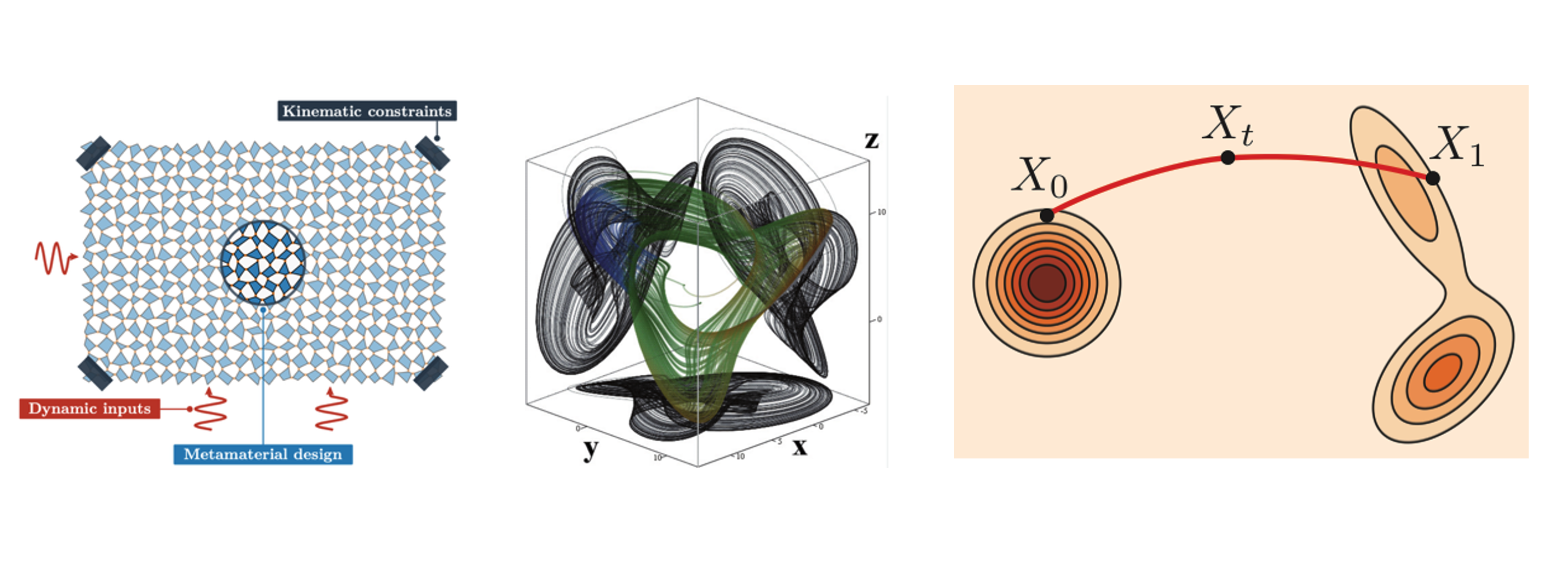
Nonlinear dynamic metamaterials are essential for advancing control over wave propagation in ways that traditional materials cannot achieve. Their engineered microstructures enable unprecedented manipulation of mechanical and acoustic waves, including directionality, frequency filtering, and energy localization. Unlike linear metamaterials, the nonlinear response offers clear advantages including adaptive and tunable behavior, allowing these materials to dynamically react to changes in amplitude or external stimuli, and enabling them to be much smaller [1, 2]. This capability is critical for applications requiring real-time reconfigurability, such as vibration isolation, impact mitigation, and signal processing in extreme environments. As modern technologies demand more responsive and intelligent systems, nonlinear dynamic metamaterials offer a transformative platform for next-generation materials design.
Due to the presence of nonlinearities and instabilities, prediction of the dynamic response becomes increasingly difficult, eventually leading to fully chaotic behavior with many possible trajectories, Figure (left), (middle). This means that standard computational techniques are not very effective and other approaches need to be adopted, predicting probability densities of achieved states in which dynamic materials operate, rather than exactly tracking individual trajectories. An ideal candidate for this purpose is machine learning technique called flow-matching, which transforms probability mass in a configuration space of a given dynamic system, cf. Figure (right) and [3]. The objective of this project is to develop a flow-matching algorithm, capable of predicting behavior of nonlinear dynamic metamaterials in terms of probability densities of their trajectories. The project will start with dynamic behavior of simple systems (such as Duffing oscillator), generalizing subsequently to realistic microstructures, and aiming ultimately towards design of new metamaterial geometries and structures.
References
[1] Dykstra, D. M. J., Lenting, C., Masurier, A. & Coulais, C. Buckling Metamaterials for Extreme Vibration Damping. Advanced Materials 35, 2301747 (2023), https://doi.org/10.48550/arXiv.2302.11968.
[2] Bordiga, G., Medina, E., Jafarzadeh, S. et al. Automated discovery of reprogrammable nonlinear dynamic metamaterials. Nat. Mater. 23, 1486–1494 (2024). https://doi.org/10.1038/s41563-024-02008-6
[3] Lipman, Y. et al. Flow Matching Guide and Code. Preprint at https://doi.org/10.48550/arXiv.2412.06264 (2024).